 VidSnag
Is Y2mate Safe? What to Use Instead (2026)
The conversion itself is fine. Y2mate is an online video converter, and saving an MP3 or MP4 isn't the dangerous part. The real risk with any ad-funded online converter is the page wrapped around it: pop-up ads, fake "Download" buttons, and redirect ads that send you somewhere you didn't ask to go. A clean, local app like VidSnag skips all of that.
Search "is y2mate safe" and you'll find strong opinions on both sides. The honest answer is calmer than either. Y2mate is one of many free online converters, and the act of turning a link into a file is harmless. What makes these sites feel risky is how they pay the bills: advertising. That advertising shows up as pop-ups, misleading buttons, and redirects. Once you separate the tool from the ads around it, the safety question becomes easy to answer for any converter, not just this one. Here's the fair version.
What actually makes online converters risky
It helps to be precise about where the risk lives, because it isn't where most people assume. The file you get from a converter is just data landing on your computer. That part is no more dangerous than saving a photo. The trouble comes from the free online page that hosts the tool, and it comes from the same place on nearly every ad-funded converter.
These sites are free because they sell ad space, and ad networks reward clicks. So the page is built, intentionally or not, to nudge you toward clicking things you didn't mean to. You'll meet pop-up ads that spawn new tabs the second you press a button. You'll see fake "Download" buttons that are really ads, sitting right next to the real one and styled to look more official. And you'll hit redirect ads that bounce you to an unrelated page, sometimes one pushing a "system cleaner" or a browser extension you never wanted.
This is worth saying plainly: that behavior is a property of the ad-funded model, not proof that any one converter is malware. The same pattern appears across dozens of similar sites. The reassuring part is that the conversion you came for is usually fine. It's the carnival of ads in the middle that you have to navigate carefully.
How to stay safe if you use one
If you do reach for an online converter now and then, a few simple habits keep you out of trouble. None of this requires technical skill, just a little patience with a busy page.
- Don't click extra buttons. The real action is usually a small, plain link or button. Ignore anything oversized, brightly colored, or labeled "Start" in a banner. Those are almost always ads.
- Avoid bundled installers. A web converter should hand you a media file, not a setup program. If a download turns into an installer, close it. You asked for an MP3, not software.
- Never install a "helper." If the site insists you add an extension, codec, or desktop "helper" to finish, walk away. A converter does not need to install anything on your machine to work.
- Use an ad blocker and keep your browser updated. A good blocker removes most of the pop-ups and fake buttons, which removes most of the risk in one move.
- Back out of redirects. If a click sends you somewhere unexpected, don't engage with that page. Close the tab and return to where you started.
Follow those and an online converter is manageable. But if you save videos or audio more than once in a while, there's a cleaner route worth knowing about.
The safer option: a local app
The biggest safety upgrade isn't a better converter site. It's moving the job off a webpage entirely and onto your own computer.
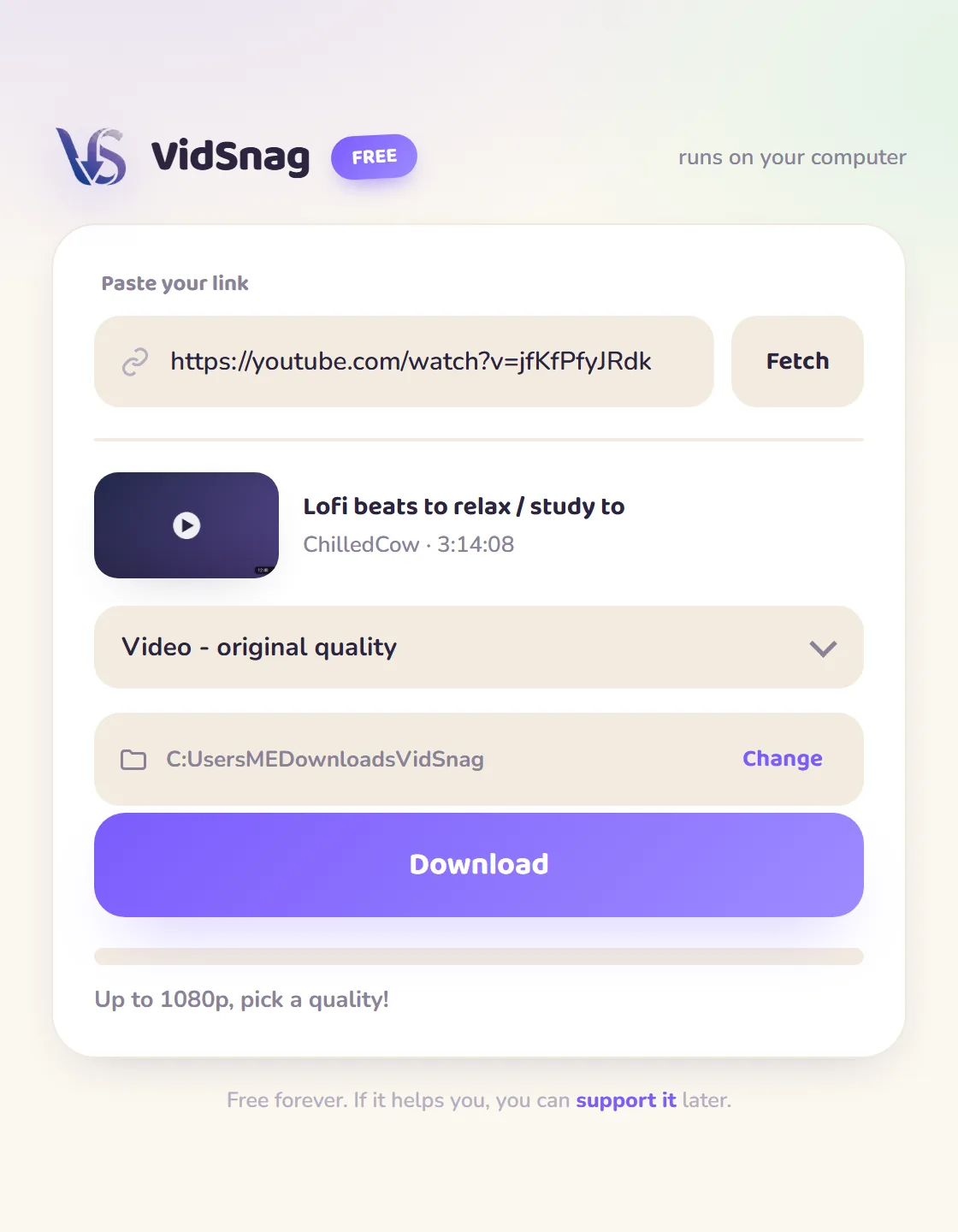
With any online tool, there's always an ad-funded page in the middle, and that page is where the pop-ups, fake buttons, and redirects live. A local app removes the page completely. You paste a link, pick a format, and save the file. There's no banner to misread and nothing to misclick, because there are no ads at all.
A local app also runs on your computer rather than on a stranger's server. The link you paste and the file you save stay with you, so nothing is uploaded to be processed elsewhere and no third party is logging what you grabbed. Fewer moving parts means fewer things to worry about. That's the whole idea behind VidSnag: a free, open-source desktop app that does the conversion locally, with no ads and no account.
| Online converters | Local app (VidSnag) | |
|---|---|---|
| Ad-funded page | Yes | None |
| Pop-ups & fake buttons | Common | None |
| Where it runs | Their server | Your computer |
| Your link uploaded | Yes | No |
| Open source | Usually not | Yes, on GitHub |
Notice what the table is really comparing. It isn't claiming online converters are infected. It's showing that the ad page is an unavoidable part of how they work, and that a local app simply doesn't have one. That single difference is where the safety gap comes from.
How to tell any tool is clean
You don't have to take a developer's word for it, online or local. Three signals do most of the work, and a trustworthy tool makes all three easy to find.
Open-source code. If the source is published on GitHub, anyone can read exactly what the program does. That openness is the strongest safety signal there is, and it's something most online converters can't offer.
A published SHA-256 checksum. This is a unique fingerprint of the file. After downloading, you can confirm your file's checksum matches the one the developer posted, which proves nothing was swapped or tampered with along the way.
A VirusTotal result. VirusTotal runs a file through dozens of antivirus engines at once. A clean scan, linked openly, is a developer showing their work instead of asking for blind trust. VidSnag publishes all three.
A converter you can actually trust
Free, open source, runs on your computer. No ads, no pop-ups, no account.
Download VidSnag freeA quick word on responsible use
Safe and responsible go together. A clean tool keeps your computer safe, and using it wisely keeps you on the right side of things. As a rule, save only content you have the right to keep: your own uploads, videos with a download or Creative Commons license, or material you have permission to use. Re-uploading or sharing someone else's copyrighted work is a different matter. When in doubt, respect the creator and the platform's terms of service.
Frequently asked questions
Is y2mate safe?
The conversion itself is fine. Y2mate is a free online converter, and saving a file is not the risky part. The risk is the ad-funded page around it, with its pop-ups, fake buttons, and redirect ads. Use an ad blocker and avoid clicking extra buttons, or use a clean local app to skip the page entirely.
Is y2mate a virus?
No, the converter is not a virus in itself. What trips people up is the advertising on free converter pages: pop-ups, fake download buttons, and redirects that can push unrelated software. That is the ad-funded model, not malware in the tool. Stick to a plain link and never install a helper it asks for.
Why does y2mate open so many pop-ups and tabs?
Because the site is funded by advertising, and pop-ups and redirects are how ad-funded pages earn money. Almost every free online converter behaves the same way. A good ad blocker stops most of them, and a local app has no ads at all.
Is y2mate legal?
The tool itself is a converter, and responsibility sits with how you use it. Saving content you have the right to keep, such as your own uploads or licensed and Creative Commons videos, is fine. Re-uploading or sharing someone else's copyrighted work is not. When unsure, follow the platform's terms of service.
Is there a safer alternative to y2mate?
Yes. A local desktop app removes the ad-funded page that causes most of the trouble. VidSnag is free, open source, runs on your computer, shows no ads, and asks for no account. You paste a link, pick a format, and save the file with nothing in the middle.
How do I know a converter is safe?
Look for three things: open-source code you can inspect, a published SHA-256 checksum to verify the file, and a clean VirusTotal scan. A tool that shows all three is proving it has nothing to hide. Most online converters offer none of them.
Is VidSnag safe?
Yes. VidSnag is open source on GitHub, publishes a SHA-256 checksum for every release, and is VirusTotal-clean. It runs on your computer, shows no ads, and asks for no account or login. There is no ad page to navigate.
Do I need to install anything or log in to use a converter?
For a web converter, no, and you should be wary if one insists you install a helper or extension. For a local app like VidSnag you install the app once, but it never asks for an account, an email, or special permissions. You just paste a link and save.