 VidSnag
Home/Blog/Is it safe to download videos?
Is It Safe to Download Videos? What to Watch For
Yes, downloading videos is safe in itself. The risk doesn't come from saving a file, it comes from where you get the tool. The sketchy ad-funded sites and apps are what cause trouble: pop-ups, fake "Download" buttons, and bundled adware. A clean, local, open-source app like VidSnag carries none of that.
If you've ever searched for a way to save a video and walked away feeling like you needed a shower, you're not alone. The act of downloading is harmless. What makes it feel dangerous is the carnival of pop-ups, redirects, and fake buttons wrapped around so many "free" tools. Once you know what's actually risky and what isn't, the whole thing gets simple. Here's what to watch for.
Where the real danger actually is
The download itself is just a file moving onto your computer. That part is no riskier than saving a photo. The danger lives in the delivery, specifically in the free online downloader sites that survive on advertising.
Because those sites make their money from ads, the whole page is built to get you to click the wrong thing. You'll see pop-up ads that open new tabs the moment you press start. You'll see big green "Download" buttons that aren't the real one, they're ads that install something unrelated. And some download links hand you an installer that bundles adware, a browser toolbar, or a "system cleaner" you never asked for. None of that is the video. It's the business model leaking onto your screen.
The takeaway is reassuring: the file you wanted is fine. It's the page in the middle you have to be careful about. Remove that page and you remove almost all the risk.
The warning signs of a sketchy downloader
You can usually spot a risky tool in the first ten seconds. Run through this quick checklist before you trust any site or app:
- Pop-ups or new tabs open before you've clicked anything you meant to.
- More than one "Download" button, or a button that's bigger and brighter than the rest of the page.
- It asks you to install a "helper," extension, or codec first.
- The installer offers to add a toolbar, search engine, or antivirus you didn't request.
- It demands an account, your email, or payment details just to save one clip.
- There's no clear company, no source code, and no checksum anywhere on the page.
- Your browser or antivirus throws a warning the moment you arrive.
One or two of these is a yellow flag. Three or more, and you should close the tab. A trustworthy tool doesn't need to trick you into a click.
How to download safely
Safe downloading comes down to a few simple habits. Follow these and the whole worry mostly disappears.
- Use a local, open-source tool. When the code is public, anyone can inspect it. That openness is the strongest safety signal there is.
- Check the file before you run it. A tool that publishes a SHA-256 checksum and a VirusTotal result is showing its work. More on that below.
- Avoid permission-hungry apps. A downloader doesn't need your contacts, your login, or admin rights to your whole machine. If it asks, walk away.
- Skip the ad-funded sites for anything you'll do more than once. The local route is cleaner and you set it up just once.
Why a local desktop app is safer than online tools
The single biggest safety upgrade is moving the download off a webpage and onto your own machine. Here's why that matters.
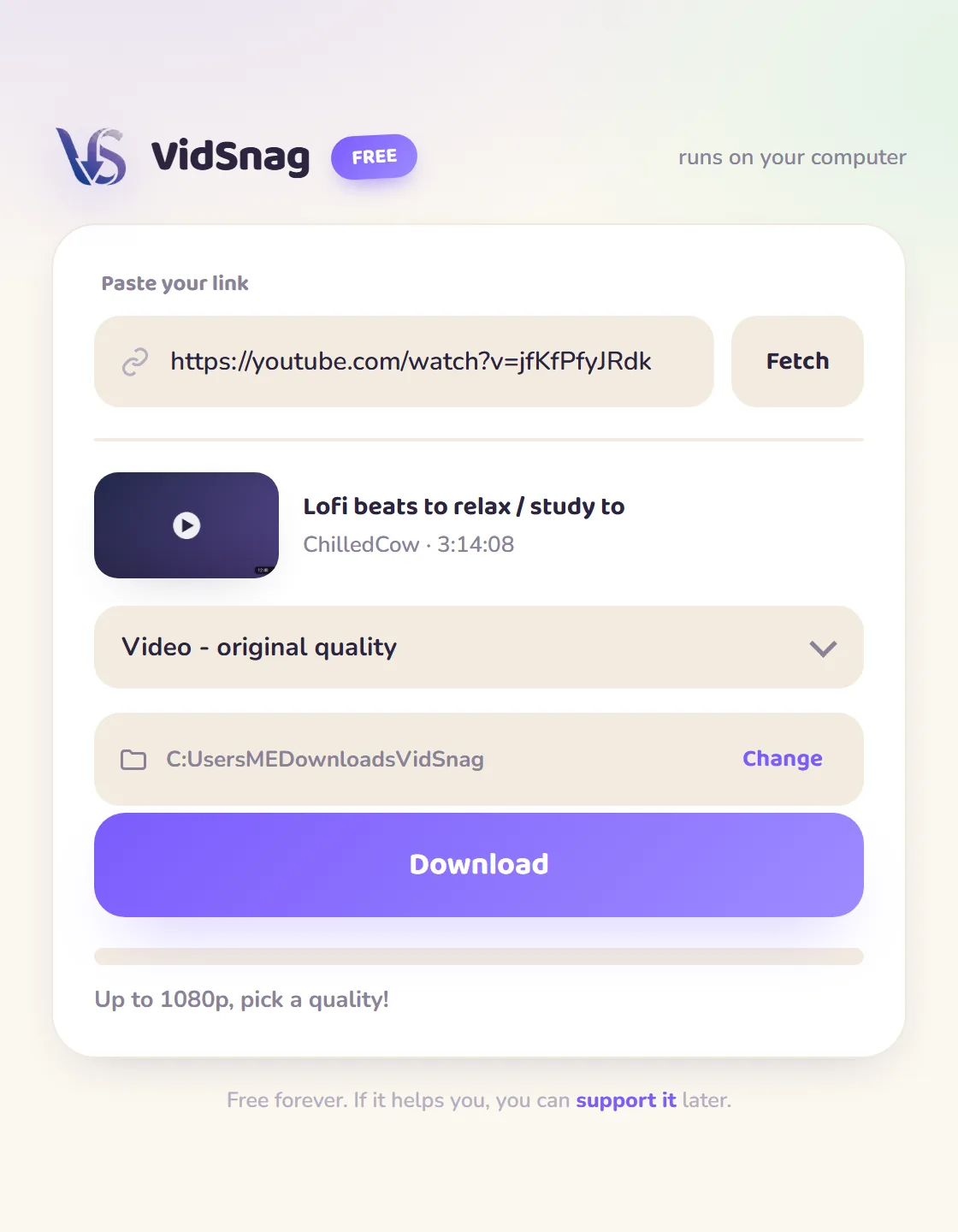
With an online tool, there's always an ad-funded page in the middle, and that page is where pop-ups, fake buttons, and bundled junk live. A local app removes that page entirely. You paste a link, pick a quality, and download. There's nothing to misclick.
A local app also runs on your computer, not on a stranger's server. That means the link you paste and the file you save stay with you. Nothing is uploaded to be processed somewhere else, so there's no third party logging what you grabbed. Less moving parts, less to worry about.
| Online sites | Local app (VidSnag) | |
|---|---|---|
| Ad page in the middle | Yes | None |
| Pop-ups & fake buttons | Common | None |
| Where it runs | Their server | Your computer |
| Your link uploaded | Yes | No |
| Verifiable code | Usually none | Open source |
How to verify a download is clean
You don't have to take anyone's word for it, and a good tool makes proof easy to find. There are three things worth checking.
Open-source code. If the source is published on GitHub, the program has nothing to hide. Anyone can read exactly what it does, which is why open-source tools are the safest place to start.
A published SHA-256 checksum. This is a unique fingerprint of the file. After downloading, you can confirm the file's checksum matches the one the developer posted, which proves nothing was tampered with on the way to you.
A VirusTotal result. VirusTotal runs a file through dozens of antivirus engines at once. A clean scan, linked openly, is a developer showing their work rather than asking for blind trust. VidSnag publishes all three.
About the "Windows: not commonly downloaded" warning
When you run a brand-new app on Windows, you might see a SmartScreen banner saying the file "isn't commonly downloaded" or "could harm your device." This trips people up, so it's worth being clear: that message is about reputation, not viruses.
SmartScreen flags any program it hasn't seen many people download yet, especially if it isn't signed with a paid certificate. A new, free, open-source app fits that description by default. It says nothing about whether the file is actually harmful. You can click "More info" and then "Run anyway" to continue, and if you want extra peace of mind, that's exactly when the published checksum and VirusTotal scan come in handy.
A video downloader you can actually trust
Free, open source, runs on your computer. No ads, no pop-ups, no account.
Download VidSnag freeA quick word on responsible use
Safe and responsible go together. A clean tool keeps your computer safe, and using it wisely keeps you on the right side of things. As a rule, save only content you have the right to keep: your own uploads, videos with a download or Creative Commons license, or material you have permission to use. Re-uploading or sharing someone else's copyrighted video is a different matter. When in doubt, respect the creator and the platform's terms of service.
Frequently asked questions
Is downloading videos safe?
Yes. Saving a video to your computer is no riskier than saving a photo. The risk comes from the tool you use, not the act of downloading. A clean, local, open-source app is completely safe.
Are online video downloaders safe?
Many aren't. The free ad-funded sites rely on pop-ups and fake download buttons to make money, and some bundle adware. The download itself is fine, but the ad-funded page around it is where the risk lives.
Can a video downloader give you a virus?
A clean tool won't. Trouble comes from sketchy sites that hand you a bundled installer or trick you into clicking a fake button. Stick to open-source apps with a published checksum and you avoid that entirely.
How do I know a downloader is safe?
Look for three things: open-source code you can inspect, a published SHA-256 checksum to verify the file, and a clean VirusTotal scan. A tool that shows all three is proving it has nothing to hide.
Is VidSnag safe?
Yes. VidSnag is open source on GitHub, publishes a SHA-256 checksum for every release, and is VirusTotal-clean. It runs on your computer, shows no ads, and asks for no account or login.
Why does Windows say "not commonly downloaded"?
That SmartScreen message is about reputation, not viruses. Windows flags new apps it hasn't seen downloaded many times, especially unsigned ones. A new free app triggers it by default. Click "More info" then "Run anyway" to continue.
Do I need to give any permissions or log in?
No. A good downloader needs no account, no email, and no special permissions. VidSnag asks for none of that. You just paste a link and download.
Is it legal to download videos?
Downloading is a tool, and responsibility sits with how you use it. Save content you have the right to keep: your own uploads, licensed or Creative Commons videos, or anything you have permission to use. Don't re-upload someone else's copyrighted work.